

Drone land surveying is quickly becoming a practical tool for faster site intelligence, especially for land development, earthworks and large projects where traditional ground capture can be slow, risky, or disruptive. For clients and design teams, the real value is simple: better information earlier, so decisions in construction planning are based on what is actually on site.
This guide explains what drone land surveying is, where it delivers the most value, how to do drone surveying properly (so the outputs are fit for engineering use), and the key New Zealand rules and permissions that need to be considered before a drone is launched.
In a hurry? What drone land surveying is best used for in NZ
- Fast capture of site levels and features for design and construction planning (especially large or hard-to-access sites).
- High-value outputs include orthophotos, point clouds and 3D surface models used for topographic surveying and earthworks planning.
- Better safety by reducing time on steep slopes, unstable ground or active construction areas.
- Strong visual context for stakeholders, designers and councils when supporting a resource consent or change request (requirements vary).
- Accuracy depends on good survey control and QA – drone data is typically combined with GNSS/total station control points.
- Drones have limits: wind/rain, heavy tree canopy, restricted airspace and operations near aerodromes may require extra approvals.
- For legal boundaries, underground services and geotechnical conditions, drones are not a substitute – they are one tool in a wider survey and design pathway.
What is drone land surveying?
Drone land surveying uses unmanned aircraft (drones) to capture aerial imagery and/or LiDAR data, which is then processed into usable spatial outputs such as orthophotos (scaled aerial maps), point clouds, contours and 3D surface models.
The drone is only one part of the survey. To achieve reliable accuracy, the data is typically tied into ground survey control using GNSS (GPS), total station observations and/or ground control points. This is why professional drone capture is usually delivered as part of a wider surveying workflow rather than a standalone flight.
Important scope note: drone outputs can support design and earthworks decisions, but they do not replace legal boundary definition, underground services locating, or geotechnical investigation. Those require a separate scope and, in some cases, separate specialists.
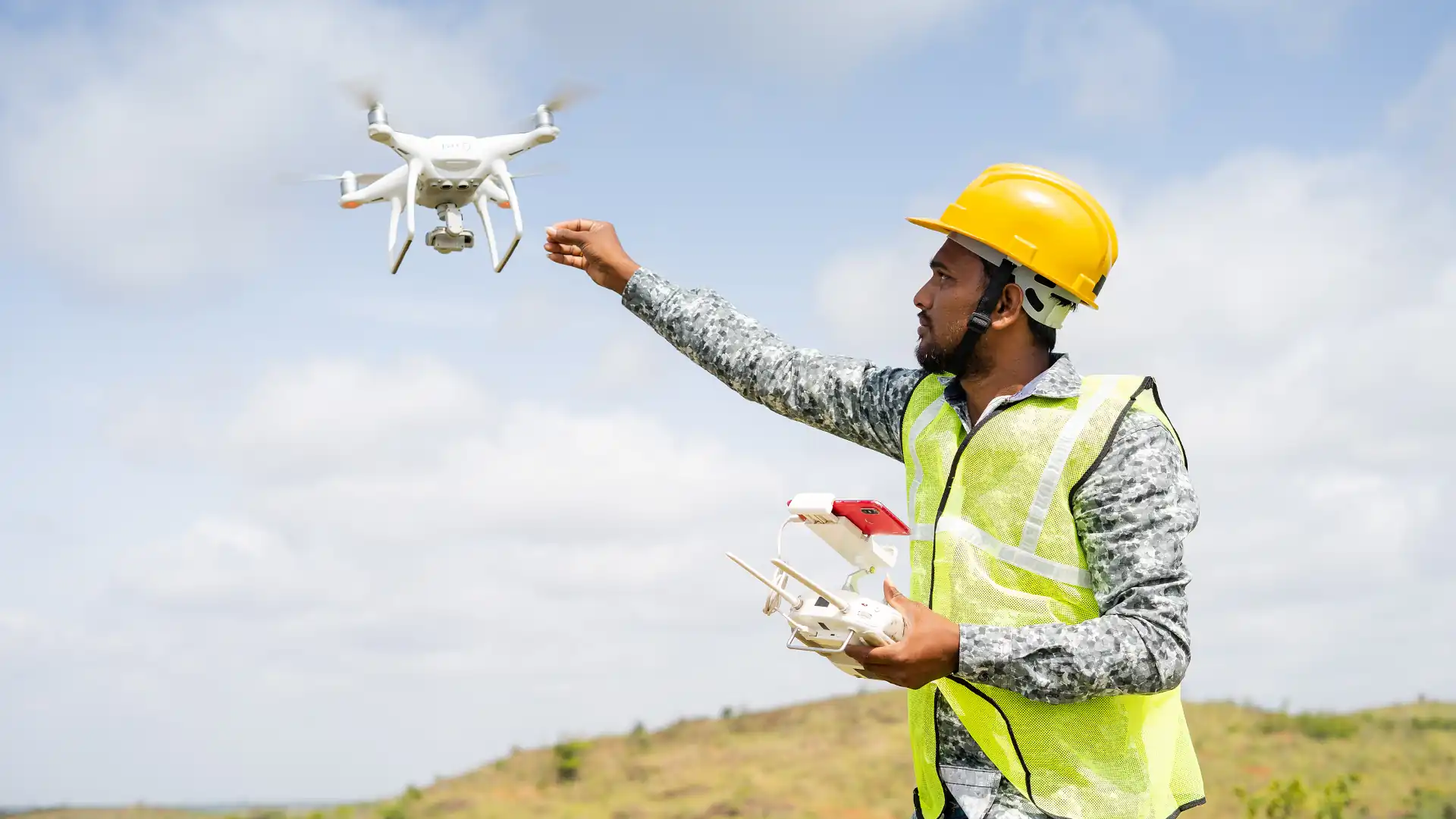
Key benefits of using drones in surveying
- Speed and coverage: capture large areas quickly, reducing site time and supporting faster decision-making.
- Safer data capture: minimise time on steep slopes, unstable ground, active work sites or environmentally sensitive areas.
- High-detail outputs: orthophotos, point clouds and surfaces that help designers see what is happening on the ground.
- Better earthworks intelligence: repeat flights can track cut/fill and stockpiles and support tighter cost control.
- Improved stakeholder communication: clear visuals can help explain constraints, options and changes to project teams and councils.
- Efficiency on complex sites: drones can be effective in rural, remote, marshy or difficult-to-access locations.
Challenges and limitations of drone-based surveys
- Weather sensitivity: wind, rain and fog can delay flights and can reduce data quality.
- Vegetation and canopy: heavy tree cover limits what photogrammetry can see at ground level (LiDAR can help, but scope and cost change).
- Airspace and site constraints: projects near aerodromes or controlled airspace may require extra planning and authorisations.
- Processing time: capture is fast, but turning data into council-ready outputs requires specialist software and QA.
- Accuracy is not automatic: engineering-grade outputs rely on good control, correct flight planning and careful processing.
Which approach suits your project? A quick guide
How to do drone surveying properly (a professional workflow)
- Scope the purpose and outputs: confirm why you need the survey (design base data, volumes, progress, as-built) and what deliverables your team requires (PDF, CAD/DWG, surface model).
- Desktop checks: review site access, hazards, and airspace constraints and confirm permissions required for safe drone operations.
- Establish survey control: set or verify control points and ground control targets where needed so the drone data can be tied into real-world coordinates and checked for accuracy.
- Plan the flight: set the right altitude, overlap and flight path for the site, taking account of wind, obstacles and the required level of detail.
- Capture the data: fly the mission safely, using RTK/PPK and/or ground control as agreed, and log what was captured for traceability.
- Process and quality check: turn imagery/LiDAR into orthophotos, point clouds and surfaces, then run accuracy checks so outputs are fit for purpose.
- Deliver and coordinate: issue the outputs in the required formats and provide clarity on scope and limitations so your designers and contractors can act with confidence.
Regulations and permissions to consider when using drones in New Zealand
Requirements can vary by airspace, site conditions and the type of operation. This is a high-level summary only, and we recommend examining the specific rules and guidelines around drone usage in the area where your project is planned.
- CAA rules apply: Most commercial survey flights operate under Civil Aviation Rules Part 101. If the operation needs to go outside Part 101, it may require Part 102 operator certification.
- Check the airspace before you fly: Restricted areas, controlled airspace and operations near aerodromes can require additional authorisations and planning (Airshare is commonly used for this).
- Stay within safe operating limits: Keep the drone within visual line of sight and below 120 m above ground level, unless you have an approved operation that allows otherwise.
- Consent matters: Operators must obtain consent where required before flying over people or over property areas involved in the operation.
- Privacy and data handling: Capture what you need, avoid unnecessary imagery of third parties, and store project data securely. Using drone data responsibly is a key part of professional practice.
What you typically receive from Kiwi Vision
- Geo-referenced orthophoto (scaled aerial image) for design context and planning.
- Point cloud and/or 3D surface model suitable for topographic surveying outputs (scope dependent).
- Contours and spot levels to the agreed interval and accuracy requirements.
- Optional cut/fill or stockpile volume calculations (where required).
- PDF outputs for documentation, and CAD/DWG outputs for consultants (where requested).
- Clear notes on the scope, control used and any limitations so the outputs are used correctly.
To scope your drone survey quickly, send us
- Site address (and legal description if available).
- A quick description of what you are doing: feasibility, design, earthworks, progress monitoring, or as-built capture.
- The area to be covered and any access constraints (gates, steep terrain, working site rules).
- The outputs you need (PDF plan, CAD/DWG, surface model, volumes, progress visuals).
- Any resource consent conditions, consultant requirements, or council requests (if applicable).
- Your timing and key programme dates (consent deadline, tender date, construction start).
- Anything that may affect flight planning: nearby aerodromes, tall structures, power lines, or sensitive neighbours.
FAQs
What is drone land surveying?
It is the use of a drone to capture aerial imagery or LiDAR data that is processed into mapping outputs such as orthophotos, point clouds, contours and 3D surface models.
How accurate is a drone survey?
Accuracy depends on the method (photogrammetry vs LiDAR), site conditions, flight planning, and the quality of ground control. When scoped correctly and tied into survey control, drone outputs can be suitable for engineering and design use.
Can a drone survey replace a traditional topographic survey?
Often it complements it. Drones are excellent for fast coverage, while ground surveying is still important for control, critical features, under-canopy detail and verification.
Can drones be used to define legal property boundaries?
No. Legal boundary definition is a cadastral surveying task. Drone data may show fences or occupation features, but that is not the same as a legal boundary.
Do I need permission to fly a drone over my site?
In many cases, yes. Drone operations must comply with CAA rules and often require consent from people and property owners/occupiers, as well as additional authorisations in some airspace. We plan this as part of the survey scope.
How long does a drone land survey take?
The flight time is usually short, but processing and quality checks take time. Turnaround depends on site size, vegetation, the required outputs and any airspace constraints.
Is LiDAR better than photogrammetry?
LiDAR can be better for sites with vegetation because it can capture more ground points, but it is not always necessary. Photogrammetry can be a cost-effective option on open sites. The right choice depends on the purpose and accuracy requirements.
Can drone survey data help with resource consent?
Often, yes. Drone-derived terrain models and site mapping can support planning and engineering assessments. What is required varies by council and consent conditions.
Drone land surveying is not a gimmick – it is a practical way to capture better site information earlier, especially on large or complex sites. Used properly, it improves design confidence, helps manage earthworks risk, and keeps projects moving with fewer surprises.
Next steps
- If you need drone land surveying for construction planning, send your site address and plans, and we will confirm scope, deliverables, timing and any airspace considerations.
- If you need outputs suitable for design or supporting a resource consent, tell us what your council or consultant requires, and we will align the deliverables accordingly (requirements vary).
- If you want end-to-end development support (surveying, planning/consenting, civil design inputs and project coordination), ask us to scope the full pathway so fewer things fall between disciplines.
- Get in touch to book a short scoping call. We support projects across Auckland, Hamilton, Tauranga and the wider Waikato, Bay of Plenty and King Country/Waitomo districts.
 English
  Chinese